Systemic Levers

Technical-Digital Solutions

Social Innovation

Partnerships and Policies

Engaging Stakeholders

Governance

Financing the Ambition
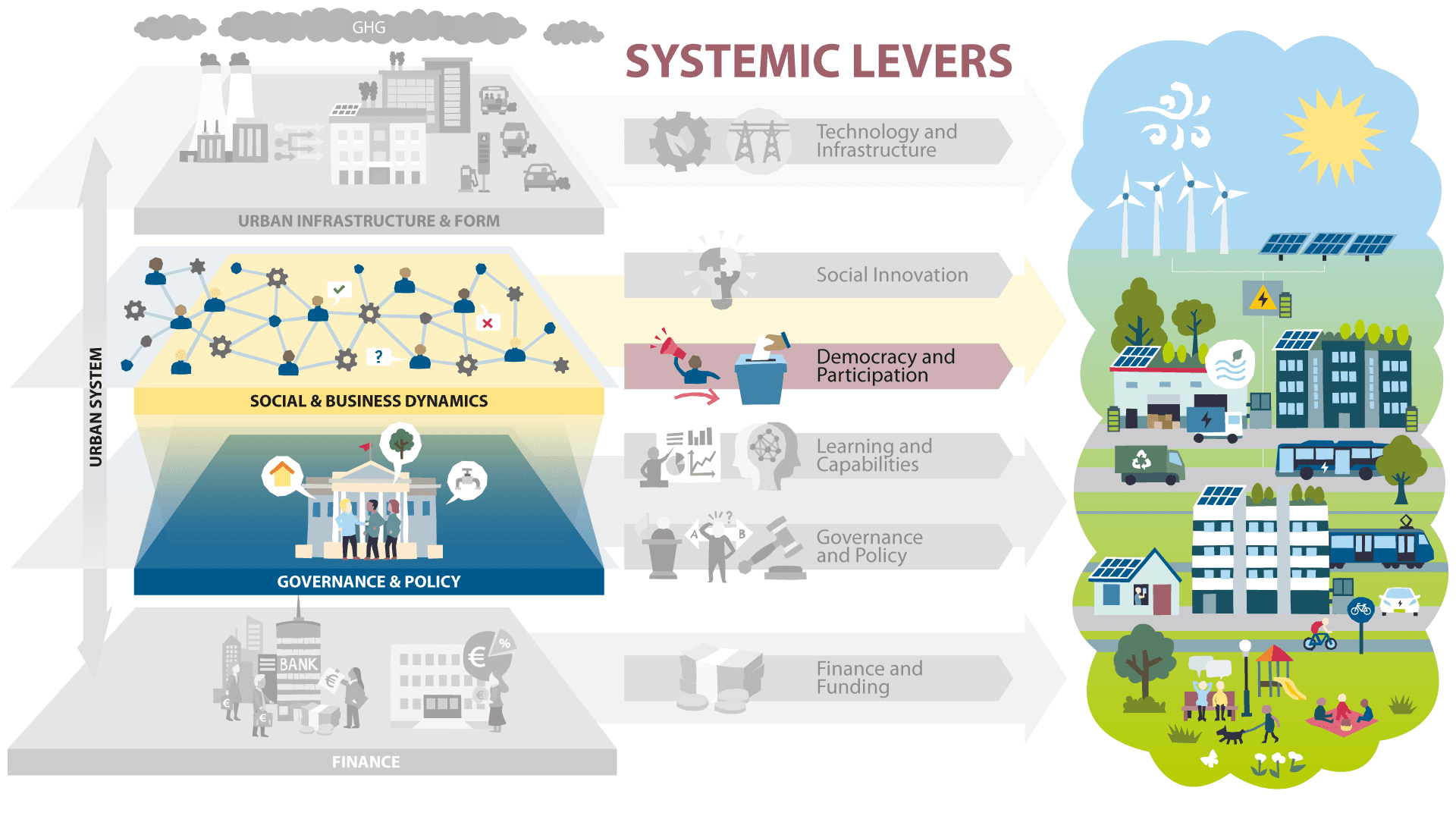
This page provides an overview of resources on the topic of Policy, Networks and Partnerships for climate neutrality

Partnerships and Policies
This page provides an overview of resources on the topic of Policy, Networks and Partnerships for climate neutrality
Reading Resources
Bringing networks to life_ nodes, relationships and context in multi-level governance.docx
-
The Two Circles of Creative Stakeholder Management
-
National Platforms to Transform Cities Using Collective Experimentation and Scale: The Case of Sweden and Spain
Chapter 8 of the book “Higher Education and SDG11: Sustainable Cities and Communities” . This text is based on the content of Chapter 8 of the book “Higher Education and SDG11: Sustainable Cities and Communities” and analyses the unique role of universities in the creation and consolidation of national platforms of cities working to become healthier, more liveable places while achieving climate neutrality.
Stakeholder Map
The Stakeholder Map has been developed to guide future work on policy and stakeholder engagement to support the successful implementation of the 100 Climate Neutral and Smart Cities by 2030 Mission and NetZeroCities.
Policy Brief on Built Environment
This policy brief provides an overview of policy needs and recommendations that can guide support in this area.
Report on consultation input to CCC concept and multi-level governance process
The deliverable D14.2 gives insight into the stakeholder engagement process conducted in five workshops
Policy Brief on Circular Economy
The following Policy Brief addresses EU decision-makers who are responsible for enabling an EU legislative framework on a clean and circular economy, particularly in circular construction and the reduction of plastics in the waste stream to achieve climate neutrality.
Annual report: strategic sub-panel
The purpose of the Stakeholder Consultation Panel is to contribute to the strengthening of a multi-level policy dialogue and alignment of policies towards climate neutrality for cities across the EU, national and regional levels.
Policy Brief on Decarbonisation of Agriculture and Food Systems
This policy brief analyses the main effects and consequences of our current food systems, offers an overview of how the EU can contribute to shifting this situation, and highlights the importance of local communities in making this change happen and ultimately ease the path towards climate neutrality.
Annual report: CCC signatories sub-panel
The purpose of the Finance and Implementation Panel is to strengthen the exchange between financing institutions and experts to ameliorate the conditions, notably financial resources available, for accelerating cities’ progress towards climate neutrality.
Policy Brief on Finance and Investment
The following Policy Brief addresses EU policymakers who are responsible for finance and investment mechanisms to support city ambitions in achieving climate neutrality by 2030.
Policy Brief on Industry Decarbonisation
This Policy Brief summarises the observations and discussions from the NetZeroCities Policy Lab on Industry Decarbonisation and contributes to the ongoing dialogues facilitated by the European Commission between Mission Cities, the industry, and national governments for Europe’s Clean Industrial Deal.
City finance and investment policy recommendations
The current report aims to provide an overview of the current state of external funding and financing used by cities (chapter 3) and of the existing EU policy landscape that impacts net-zero investments by the financial sector in cities (chapters 4).
Policy Brief on Mobility
This Brief focuses on the regulatory and policy challenges faced in Thessaloniki and Madrid, supported by insights and recommendations from an additional 20 cities.
Policy framework media package
This document provides guidance to the parties responsible for portal integration of the Policy Framework.
Policy Brief on Nature-Based Solutions
EXECUTIVE SUMMARY2 This Policy Brief is building on regulatory and policy challenges faced in Lahti and Sevilla while deploying nature-based solutions (NbS)
Policy Brief on Supporting Energy Communities
EXECUTIVE SUMMARY2 This Policy Brief addresses the EU and Member States’ national-level decision- makers responsible for designing the EU legislative framework on Renewable and Citizen Energy Communities (RECs and CECs).
EU Policy Framework
The policy framework provides an overview of the EU level policies that are most relevant to achieving climate neutrality in cities by 2030.
Policy framework media package
City finance and investment policy recommendations
Annual report: CCC signatories sub-panel
Annual report: strategic sub-panel
Report on consultation input to CCC concept and multi-level governance process
Stakeholder map
Stakeholder perspectives on EU Urban Data Governance 2025
Policy Brief on Supporting Energy Communities Policy Brief
Policy Brief on Nature-Based Solutions
Policy Brief on Mobility
Policy Brief on Industry Decarbonisation Policy Brief
Policy Brief on Finance and Investment
Policy Brief on Decarbonisation of Agriculture and Food Systems
Policy Brief on Circular Economy
Policy Brief on Built Environment
Projects maps
Interactive tables of projects by category
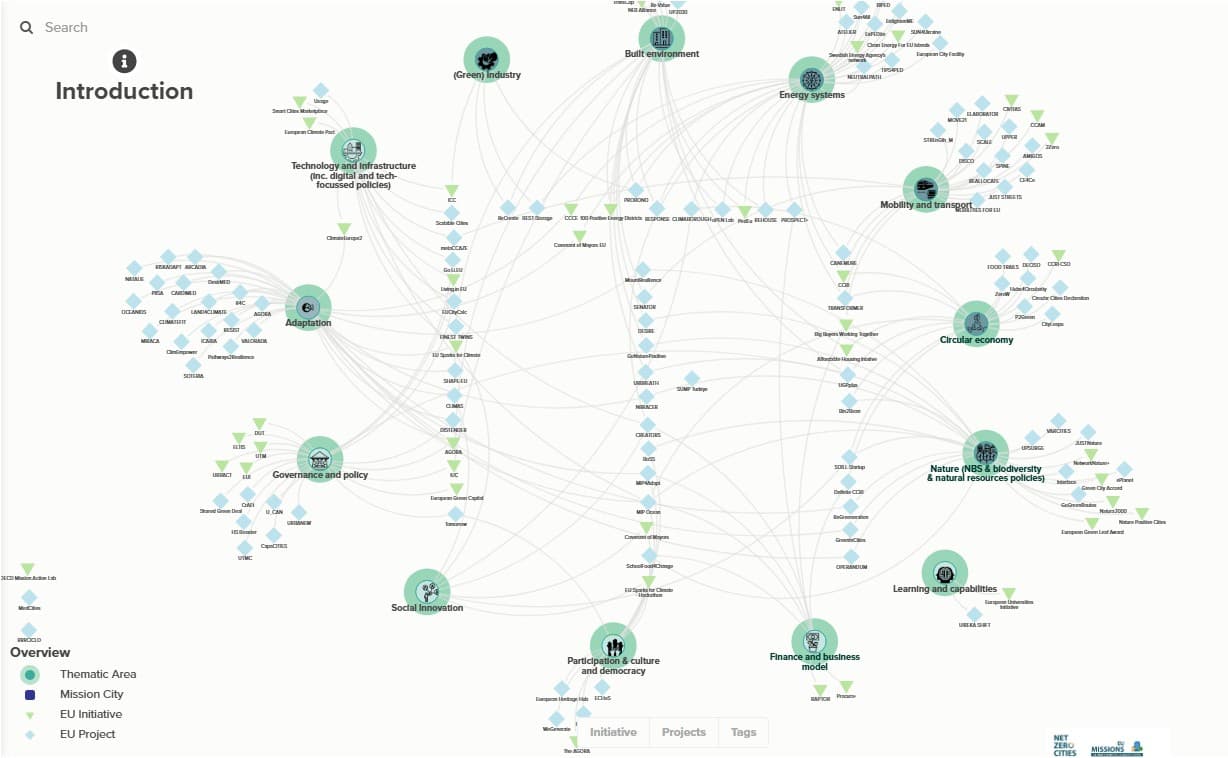
The EU Climate Projects Navigator
The EU Climate Projects Navigator provides cities with an overview of major EU-funded initiatives and projects that support cities’ progress to climate neutrality by 2030. It illustrates which projects correspond to cities’ impact pathways and it highlights resources from individual projects that are accessible to cities via project websites.
Stakeholder perspectives on EU Urban Data Governance 2025
This document summarises discussions from the two dialogues organised by NetZeroCities with the support of Living-in-EU and the Smart Cities Marketplace.
Case Studies
Description The NetZeroCities Course is designed for professionals, policymakers, and changemakers committed to driving climate action.
National Platform: France
This resource explains how France is advancing the EU Cities Mission through the National Groupe Miroir Ville (GMV), an informal yet increasingly influential coordination space that brings together ministries, agencies, cities, networks, and research institutions. It is useful for cities and stakeholders because it shows how regular exchange, shared learning, and emerging multi‑level collaboration can strengthen climate governance, support the development of Climate City Contracts, and build the foundations for effective implementation despite limited formalisation and funding.
National Platform: Italy
This resource outlines how Italy is building an emerging national ecosystem for climate‑neutral cities by connecting Mission Cities, national ministries, networks, and technical teams through shared processes and collaboration spaces. It is useful for cities and stakeholders because it shows how multi‑level coordination, continuity, and shared learning can help sustain climate action even amid institutional change, offering inspiration for developing similar national platforms elsewhere.
citiES 2030: Spain
citiES 2030 is Spain’s national platform that empowers Mission Cities and Mission‑minded cities to accelerate their transition to climate neutrality through multi‑level coordination, shared learning, and collaborative project development. It is a valuable resource for cities and stakeholders because it connects local actors with national and European frameworks, mobilises expertise and funding, and supports the co‑creation of scalable solutions for urban transformation. It deeps dive on the origin and evolution of citiES 2030
Towards a National Platform: Türkiye
Türkiye's Climate‑Neutral Cities Network (İNŞA) brings together 55 municipalities in a nationally coordinated effort to accelerate climate neutrality through capacity building and peer learning. It shows how a country outside the EU can successfully build a national ecosystem for climate‑neutral cities, offering practical lessons on coordination and scaling Mission‑oriented approaches.
Participation, Culture and Democracy in Cities
Strategic Public Procurement (SPP)
Policy Labs
Learning from Cities
A map is loading