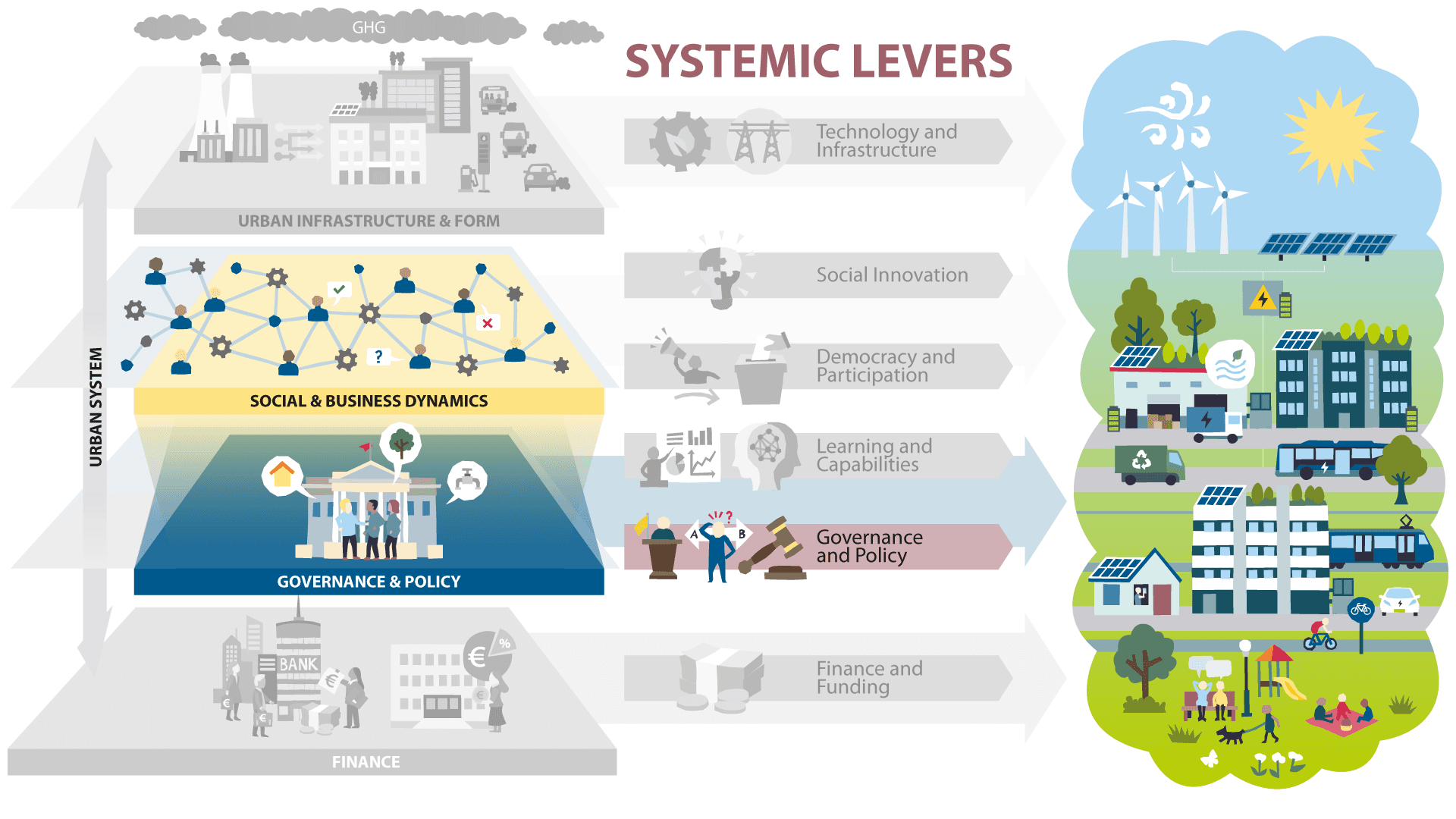

Systemic Levers
image
Climate governance refers to the different ways that cities, other government levels and societal actors use to steer towards climate-neutrality, especially through holistic thinking and collaboration.
location_pin
Governance

Governance innovations can enhance the capacity of actors to reach climate neutrality. The better we govern collective action, the faster and fairer the required transformation is achieved.

Governance refers to both the “hard” (e.g. regulations, strategies, policies) and “soft” (skills, mindset, forms of collaboration) elements enabling or hindering societal transformation. Climate governance refers to the different ways that cities, other government levels and societal actors use to steer towards climate-neutrality, especially through holistic thinking and collaboration. Instead of one-off, sticking-plaster solutions, climate governance focuses on how the different strategies, actions, technical and social tools, etc., work together as a whole. Key elements of climate governance in cities

The next four interconnected modalities of climate governance help to look at the different levels and ways that change can be pursued in cities:

Domain-specific governance

‘Hard’ governance of systems, processes, and strategies in specific key domains (e.g. city planning, mobility, energy).

Cultural change

‘Soft’ governance of the culture, mindset, and capacities of the organisation and the people within it.

Capacity for ecosystem leadership

The ways in which cities interact with and incentivise the broader city ecosystem (e.g. private actors, citizens, civil society).

Multilevel governance

Governance of collaboration between cities in different forms and for different purposes as well as city-national and city-EU

Reading Resources
Reducing Resource Demand in Climate-Neutral and Just European Cities: Sufficiency as a Policy Tool for Fair and Sustainable Urban Transitions
This NetZeroCities deep-dive report explores how sufficiency can serve as a tool for fair and sustainable transitions in European cities working toward climate neutrality. As research increasingly shows that efficiency and technological innovations alone are insufficient to meet climate neutrality targets, sufficiency complements the strategies by addressing the scale and fair distribution of resource demand and consumption. Sufficiency is understood as meeting people’s needs while staying within planetary boundaries. For cities, it can mean finding ways to reduce demand for energy, materials, land and water while ensuring a good life for a
Stitching the City – Valencia as a Laboratory for Democratic Infrastructure
This article explores how a climate crisis in Valencia was used to prototype democratic infrastructure through civic hubs (“Spaces for Encounter”) enabling collaboration between citizens and institutions. It is useful for cities as it offers a replicable model to scale participatory governance and community-led climate action beyond emergency responses.
Quick Read: Governing the Climate Transition
Governance innovations can enhance the capacity of actors to reach climate neutrality. The better we govern collective action, the faster and fairer the required transformation is achieved.
Bringing networks to life_ nodes, relationships and context in multi-level governance.docx
-
The Two Circles of Creative Stakeholder Management
-
System Change: A Guidebook for Adopting Portfolio Approaches
This UNDP guidebook presents an approach to help a broad range of development practitioners prepare for, engage in, and manage systems transformation using a portfolio approach in complex development spaces. We developed this guidebook as a way to formalize our process and learnings to date, and leverage these to support others as they initially contemplate—and eventually work towards implementation of a portfolio-based approach for addressing complex development challenges in their own context. It captures the on-the-ground applied learning from a United Nations Development Programme (UNDP) sponsored project throughout Asia-Pacific from October 2019 to September 2021.
The wild city: collaborative practices in urban renaturing
This book explores the various threads, challenges and chances which both art and science might encounter in co-creating NBS, pointing to recover, recreate or reinvent nature in more humanized urban landscapes. The purpose of this compilation is thus to give consistency to a novel state of practice, depicting the increasing benefits and diverse approaches of collective intelligence and co-creation for NBS and provide a detailed analysis of methodologies in the relationship between diverse social agents.
Social Innovation Projects for Climate Neutral Cities: Making Municipalities Sustainable with People-Based Solutions
This open access book examines the role of social innovation in cities as an important lever towards climate neutrality. Social innovations are people-centred collaborative solutions, activating the urban ecosystem for change and providing platforms for citizens, civic organizations, the private sector, and governmental institutions to collaborate towards the goal of reducing greenhouse gas (GHG) emissions. The book, based on work developed within the EU-funded project NetZeroCities, which aims to support over 100 European cities to be climate-neutral by 2030, outlines methods, cases, and pathways of social innovation in Europe. It presents social innovation design process pathways through methods, categories of actions, and related cases for developing and scaling social innovations at the urban level, contributing to a systemic approach to tackle the grand challenge of reaching net zero. Within these pages, researchers and policymakers can find examples of cities that have deployed innovative public administration practices by systemically embedding social innovation in varied fields of urban action plans, including energy, citizen engagement, and behavioural change for lowering carbon emissions and increasing well-being.
Governing Together – Bridging Divides in Everyday Politics
Governing Together reimagines governance as something built with and for relationships – an approach that shifts how we understand our place in the world, how we relate to one another, and how we design, decide, and act across divides.
Recommendations and best practices for regional and national endorsements and commitments in the Climate City Contracts
This resource is designed to support Mission Cities seeking to strengthen their collaboration with regional and national authorities, helping to secure impactful commitments in future iterations of their Climate City Contracts. Additionally, the document serves as an inspiration for regional and national authorities, offering practical recommendations and ideas for endorsing or contributing meaningful commitments to support cities on their journey to climate neutrality.
Recommendations for supporting municipalities in integrating Climate Action into the urban planning system
This guidance, developed under the NetZeroCities Project and funded by the City Expert Support Facility (CESF), aims to support municipalities—specifically Vitoria-Gasteiz—in aligning their urban planning with climate goals. It provides a structured framework to integrate climate action into the General Urban Planning Plan (PGOU), fostering sustainable, climate-resilient cities through collaborative, multidisciplinary approaches.
Futures deepdive - Full Electrification Risks
This deepdive addresses the electrification risks that cities in Europe face in the transition to sustainable, low-carbon energy systems. It explores key challenges such as rising energy demand, critical materials shortages, and the complexities of decarbonizing urban infrastructure while ensuring environmental and social equity. The deliverable provides an in-depth analysis of the risks associated with sourcing and production of clean energy technologies, environmental impacts, workforce shortages, and the financial barriers to the energy transition.
Futures deepdive - Integrating Adaptation and Mitigation
This deep dive provides an exploration of the integration of climate change mitigation and adaptation strategies in urban contexts, with particular attention to pathways for resilience and justice in European cities. It is situated within the broader framework of the NetZeroCities (NZC) programme, which supports the transition towards climate-neutral, sustainable, and inclusive urban futures. The study considers the historical predominance of mitigation over adaptation, the increasing recognition of the need to integrate the two approaches, and the shift in climate narratives that emphasise justice, equity, and human-centric perspectives alongside technical solutions. Key issues addressed include the lag in adaptation planning, challenges in financing holistic climate action, risks of maladaptation, and the importance of embedding justice frameworks and local self-determination. The role of nature-based solutions (NbS) as integrative tools is also examined.
Governance Innovation and Implementation in the Cities Mission - Multi-Level Integration
This report examines multi-level governance integration within the EU Cities Mission, highlighting how cities utilize collaborative frameworks across governance tiers to support their climate neutrality goals. Analyzing the cities of Aachen, Kozani, and Turku, the report illustrates diverse governance approaches influenced by distinct national contexts.
Governance Innovation and Implementation in the Cities Mission - Multi-Actor Collaboration in Mission City Climate Action: Private Sector Engagement
This report explores governance innovation and implementation strategies for engaging the private sector in climate action within the EU Cities Mission framework, emphasising multi-actor collaborations. The study examines approaches to stakeholder engagement, partnership structures, implementation processes, and private sector motivations through analysing four diverse cities: Gothenburg, Guimarães, Budapest, and Valladolid.
Governance Innovation and Implementation in the Cities Mission: Anticipatory Governance in City Climate Planning and Policy
This report examines how four European Mission cities Umeå, Tampere, Valencia, and Parma are integrating anticipatory governance approaches into their climate planning to better navigate uncertainties while pursuing climate neutrality. As participants in both the EU Climate- Neutral and Smart Cities Mission and the Adaptation Mission, these cities are developing innovative strategies to enhance resilience and adaptability in their climate transition work.
Building adaptive climate action in cities: Anticipatory Climate Governance
This guide aims to help cities to explore and apply future-oriented methods towards their climate goals, and ultimately develop their ability to steer towards a desirable future for their city and residents, adapting over time to different trends and dynamics. This is captured through the approach of ‘Anticipatory Climate Governance’ including its value to cities and their climate action; how this goes beyond methods and isolates use cases. It offers practical insights and actions for both experienced cities and those new to futures thinking, aiming to enhance their capacity for long-term, adaptive, and transformative climate planning.
Sarajevo: Participatory Governance, Nature-Based Solutions and Sustainable Mobility
A city of about 300,000 residents, shaped by its valley geography, complex governance, and rich heritage, is pursuing sustainable urban transformation through participatory governance, greener public spaces, and more sustainable mobility, while collaborating with peer cities to share practical context-sensitive approaches and adaptable financing models for climate action. This document was prepared in advance of the Group Study Visit to outline the practices to be shared.
Humble Governance for climate action in Umea
As in cities everywhere, achieving Umeå’s goal of climate neutrality relies on coordinated action across the public and private sectors, as well as active engagement with the broader community. To help build effective partnerships that lead to concrete and impactful climate action, a new partnership model was co-developed by the City of Umeå together with Demos Helsinki and the members of the local climate partnership Umeå Climate Roadmap. This project was supported by funding from the EU Cities Mission, provided through the City Expert Support Facility (CESF) of NetZeroCities.
Governance EU Climate Neutrality Framework
A list of key EU legislations aim at transforming and decarbonising the European building stock.
Leveraging Foresight and Anticipatory Governance in Cities’ Climate Action
This article aims to inspire cities to explore and apply future-oriented methods towards their climate goals, and ultimately develop their ability to steer towards a desirable future for their city and residents, adapting over time to different trends and dynamics.
Introduction to Climate Governance in Cities - Leading Societies Towards Climate Neutrality
An article breaking down what climate governance is in cities, why governance is key, four modalities to use as a lens for looking at it, and how to strengthen and apply climate governance in your city.
Quick read: Governing a transition to climate-neutrality
An overview on climate governance looks at the different levels and ways that change can be pursued in cities.
Ecosystem Activation Tools (PDF Version)
This resource provides a set of diagnostic tools (Ecosystem Activation Tools) to assess local engagement needs and identify appropriate strategies for involving citizens and stakeholders. It helps cities prioritise actions and connect with complementary engagement services to activate and strengthen their local ecosystem for climate transition.
Beyond One-Off Participation: Building Long-Term Citizen Engagement for Climate Action
This article presents three approaches to long-term citizen engagement for climate action—Participation Practice, City as Enabler, and Transition Governance—highlighting how to embed participation into systems and governance. It is useful for cities working on climate neutrality as it provides practical models to institutionalise participation, build trust, and enable sustained collaboration with citizens.
Desktop research report on engagement
In this report, we make the case for cities to transform decision-making processes and engage citizens and urban stakeholders in meaningful participation to contribute towards this goal.
Climate City Contract Progress: Insights from Mission Cities
Our upcoming report showcases the progress and challenges faced by Mission cities developing a Climate City Contract.
Book "Assessment Framework for People-Centred Solutions to Carbon Neutrality A Comprehensive List of Case Studies and Social Innovation Indicators at Urban Level"
This open access book presents a catalogue of over one thousand indicators which can be used by cities' public administrators to monitor and evaluate social innovation action plans to support people-centred, collaborative or co-designed solutions to lower carbon emissions.
Focus Page: Citizens and urban stakeholders engagement
On this page you can find the list of all NZC resources on citizen and urban stakeholder participation
Methodologies to scale up social innovations
This deliverable describes the activities conducted in NetZeroCities project tasks T9.2 Methodologies and tools for social innovation design/prototyping and testing, and T9.3 Methodologies for scaling bottom-up social innovations.
Transition team playbook
A guide to develop a city’s ability to lead a collective endeavour: to orchestrate a climate transition.
Case Studies
Description The NetZeroCities Course is designed for professionals, policymakers, and changemakers committed to driving climate action.
The Role of Philanthropy in Turin’s Urban Climate Transition
This case study examines the contribution of Fondazione Compagnia di San Paolo to Turin’s pathway toward climate neutrality through two complementary initiatives: the CLICC project and the TPL Carbon Free Innovation Center. Together, these initiatives illustrate how philanthropy can operate both as a builder of systemic urban capacities and as an accelerator of sector-specific innovation. Rather than acting solely as a source of funding, the foundation plays a strategic role in strengthening governance, enabling experimentation and fostering collaboration across institutional and sectoral boundaries.
Malmö’s bold road to climate neutrality: A model for systemic change
-
Systemic innovation in Umeå requires creative energy and a black belt in bureaucracy
A case study of how Umeå set out to overcome organisational silos and fragmented climate governance by combining systemic innovation methods with cross-sector collaboration. Through its North Star Pilot, the city embedded Innovation Officers within municipal departments and equipped senior leaders with transition training, creating both internal connectors and visible champions for climate action. Rather than focusing on a single technical fix, the initiative strengthened relationships, aligned departments around shared goals, and formalised new leadership roles such as a Chief of Sustainability.
Antwerp's Participatory Budget
The Participatory Budget is a tool for the City of Antwerp to give citizens autonomy to spend 10% of the city’s budget annually on projects that could enrich their lives.
Pécs: Climate Governance, Circular Economy and Urban Decarbonisation
Pécs Market Hall initiative to phase out single-use plastic bags through reusable alternatives, incentives, and consumer awareness.
Prato: Circular economy solutions & urban governance in a highly industrialised textile city
Prato mechanical textile recycling model focused on SMEs
Ioannina: Local groups collaborate for climate neutral zones
Shows co-creation of climate-neutral zones in Ioannina integrating mobility, buildings, and nature-based solutions.
3D Participatory Approach to Stakeholder Engagement
Guimarães has designed and implemented the 3D Participatory Approach, a stakeholder engagement model built on three dimensions: creating identity, transforming the landscape, and building the future.
Budapest Climate Agency
Budapest has launched a Pilot Activity, Budapest CARES - Climate Agency for Renovation of homES, to develop and deploy strategic, institutional, and financial support mechanisms and initiatives for building retrofit, with the ambition of accelerating the transition.
One-Stop Platform for Climate Communication
Turku developed and launched a new multilingual digital platform on the municipal website. It's a digital space that serves multiple audiences (residents, businesses, city staff, and leadership) and provides tailored content and tools on climate and nature topics to different users.
Strengthening Just Transitions Through the Core Functions of National Platforms
National platforms are to support cities and accelerate European climate agendas by strengthening coordination and cooperation across governance levels. Working with diverse stakeholders brings challenges related to differing interests and power dynamics. Applying a Just Transition perspective helps national platforms address these challenges and foster more balanced, inclusive and fair climate action processes.
Padua: Governance Model for Renewable Energy Communities
Padua, a mid-sized city in northern Italy, is one of the EU Mission Cities aiming to become climate-neutral by 2030. As part of the Mission, Padua has developed a Climate City Contract through a collaborative governance model involving local stakeholders. Among the key actions identified for decarbonisation is the development of Renewable Energy Communities (RECs) to enable a shift from fossil fuel-based energy systems to distributed renewable energy production, which requires coordination among technologies, institutions, and citizens.
Bristol's Pilot City Activity: Net Zero Investment Co-Innovation Lab
The Bristol Net Zero Investment Co-innovation Lab is to create a series of financial mechanisms to accelerate decarbonisation of the city, facilitating investment and supporting zero carbon business growth. It will develop financial mechanisms that can become self-sustaining and mutually supportive, enabling a fast and fair transition to net zero.
Lyon's Pilot City Activity: The Climate Hall Lyon 2030
Lyon's pilot in NetZeroCities seeks to strengthen the involvement of citizens and local stakeholders by promoting skills development and synergies, and the multiplication of initiatives through the prefiguration of a flagship venue on climate and resilience.
Vision workshop in Sztum (Poland) - inspiring collaboration for climate neutrality
This resource presents Sztum’s Vision Workshop as an inclusive, participatory format that brings together local stakeholders to explore everyday perspectives on climate neutrality. It highlights how collective reflection and co-creation can help build a shared vision for a climate-neutral future grounded in people’s lived experiences.
Scotland's Climate Assembly
This resource explores Scotland’s Climate Assembly as a national deliberative process bringing together randomly selected citizens to discuss and shape responses to the climate crisis. It highlights how online participation, structured deliberation, and expert guidance contributed to citizen-led recommendations, while also reflecting on challenges around engagement, policy impact, and long-term influence.
Resilient BoTu 2028
This resource explores Resilient BoTu 2028 in Rotterdam as a community-driven approach to climate transition that uses the energy shift to strengthen social cohesion and local capacity. It highlights how Asset-Based Community Development empowers residents, builds local skills and jobs, and addresses energy poverty through integrated, neighbourhood-level action.
People's Policy on Child Wellbeing
This resource presents the People’s Policy on Child Wellbeing in South Australia as a citizen-led policymaking initiative, where residents collaboratively developed policy through a deliberative process. It highlights how shifting decision-making power to citizens can redefine traditional governance and strengthen democratic legitimacy.
Paris' Standing Citizens' Assembly
This resource presents the permanent Paris Citizens’ Assembly as a pioneering example of institutionalised deliberative democracy, bringing together 100 randomly selected residents to represent the diversity of the city. It highlights how civic lottery-based assemblies can embed ongoing, representative citizen participation in public decision-making.
Living Streets of Ghent
This resource presents the Living Streets of Ghent as a citizen-led urban experiment that temporarily transforms streets into car-free, social spaces. It highlights how co-design and real-life testing can improve liveability, shift mobility behaviours, and support long-term transitions toward more sustainable and people-centred urban environments.
Grenoble Alpes Métropole’s Citizen Convention for Climate
This resource examines Grenoble Alpes Métropole’s participatory climate convention, showing how strong political commitment, stakeholder engagement, and dedicated funding enabled the co-creation of climate mitigation strategies with citizens. It also highlights key challenges—such as coordination, planning, and costs—while offering lessons on how to design impactful, legitimate, and replicable citizen assemblies.
Wards Corner, Public-Commons Partnership (PCP)
This case study presents Wards Corner in London, where a Public-Commons Partnership (PCP) enables community co-ownership and democratic governance of a local market redevelopment. It shows how community-led models can shape urban development, preserve local economies, and promote inclusive, shared decision-making.
Crowdsourcing the Mexico City Constitution
This case study presents how Mexico City used crowdsourcing (surveys, petitions, kiosks, assemblies) to involve citizens in drafting a new constitution. It shows how multi-channel participation can strengthen democratic decision-making and integrate citizen input into large-scale policy frameworks.
Participatory environmental monitoring committees in mining contexts
This case study presents a community-led environmental monitoring committee in Panama using citizen science to track water quality and hold a mining company accountable. It shows how participatory monitoring can improve environmental governance, transparency, and local capacity to address pollution impacts.
Democratic energy transition in Amsterdam
This case study explores the democratic energy transition in Amsterdam, using the Climate Democracy Model to strengthen civic engagement, collaboration with energy communities, and experimentation with new governance approaches. It shows how inclusive, participatory frameworks can shift energy transition from technocratic planning to community-driven, equitable climate action.
EmpowerMed
This case study presents EmpowerMed, a project tackling energy poverty through community empowerment and participatory approaches (Collective Advisory Assemblies). It shows how peer learning and data-driven insights can support more inclusive and just climate transition outcomes.
Citizens' Climate Assembly
The Citizens' Climate Assembly was a deliberative process of 100 people chosen by lottery between the ages of 16 and 75 to discuss the climate emergency situation in the city and they defined actions and solutions to improve it, answering the question: What can we do to address the climate emergency?
Supporting cities in achieving their climate neutrality objectives: Poland
The Polish national platform for facilitating the implementation of the Cities Mission was launched at the end of 2023. Its objective is to foster closer collaboration and alignment among the national, regional and local levels, and to provide direct support to the five Mission Cities in their climate neutrality work
Viable Cities Journey: Climate transition through Collaboration and Multi-level Governance
This resource presents Viable Cities’ mission-driven governance model—combining Climate City Contracts, transition teams, transition arenas, and Climate Investment Plans—to help cities break silos and mobilise all actors for climate neutrality by 2030. It is valuable for cities and stakeholders seeking practical, scalable methods to strengthen collaboration, secure long‑term commitment, and accelerate the transition in line with the EU Cities Mission.
National Platform: France
This resource explains how France is advancing the EU Cities Mission through the National Groupe Miroir Ville (GMV), an informal yet increasingly influential coordination space that brings together ministries, agencies, cities, networks, and research institutions. It is useful for cities and stakeholders because it shows how regular exchange, shared learning, and emerging multi‑level collaboration can strengthen climate governance, support the development of Climate City Contracts, and build the foundations for effective implementation despite limited formalisation and funding.
citiES 2030: Spain
citiES 2030 is Spain’s national platform that empowers Mission Cities and Mission‑minded cities to accelerate their transition to climate neutrality through multi‑level coordination, shared learning, and collaborative project development. It is a valuable resource for cities and stakeholders because it connects local actors with national and European frameworks, mobilises expertise and funding, and supports the co‑creation of scalable solutions for urban transformation. It deeps dive on the origin and evolution of citiES 2030
Towards a National Platform: Türkiye
Türkiye's Climate‑Neutral Cities Network (İNŞA) brings together 55 municipalities in a nationally coordinated effort to accelerate climate neutrality through capacity building and peer learning. It shows how a country outside the EU can successfully build a national ecosystem for climate‑neutral cities, offering practical lessons on coordination and scaling Mission‑oriented approaches.
Spotlight on National Platforms
The case describes what a National Platform is and highlights its added value for cities, showing how it strengthens coordination across governance levels, removes implementation barriers, and provides practical tools, funding pathways, and peer‑learning opportunities to accelerate climate action.
Reflective MEL
This report focuses on Reflexive Monitoring, Evaluation, and Learning (MEL) as a critical component of city climate governance under the EU Cities Mission, based on the case studies from Barcelona (Spain), Cluj-Napoca (Romania), Košice (Slovakia), and Porto (Portugal)
Ghent guiding business in energy efficiency
Ghent has identified companies as an important target group for CO2 reduction and set up a customised coaching scheme to encourage investment in energy efficiency measures when existing simple energy audits failed to lead to action.
The Bristol Net Zero Investment Co-innovation Lab
Bristol’s Climate Strategy identifies the need for innovative finance mechanisms as a systemic requirement for the decarbonisation of the city.
Oslo’s Climate Budget
Oslo’s Climate Budget is a pioneering approach to mainstreaming climate into decision-making processes, believed to be the first of its kind, which Oslo considers to be the most important tool for achieving its climate targets.
Climate Hall, Lyon
This pilot seeks to strengthen the involvement of citizens and local stakeholders by promoting skills development and synergies, and the multiplication of initiatives through the prefiguration of a flagship venue on climate and resilience – the Climate Hall.
Leuven 2030
In 2013, Leuven set up Leuven2030, a municipal authority group involving NGOs, businesses and many other participants tasked with delivering carbon neutrality by 2030.
Viable Cities
Viable Cities is a Swedish strategic innovation programme for climate neutral and sustainable cities.
Showcase
Learning from Cities

A map is loading