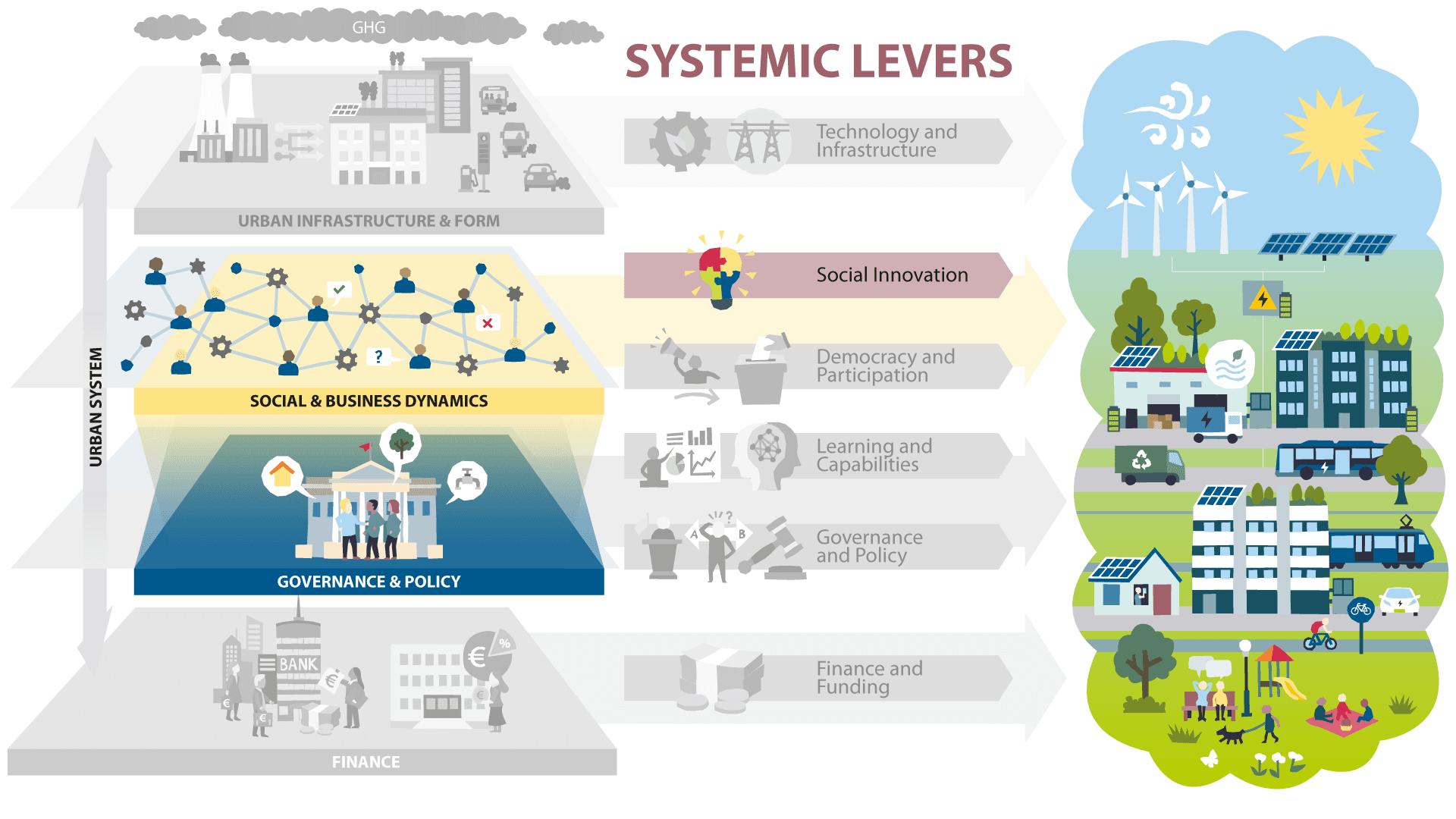

Systemic Levers
image
Social innovation addresses the challenge of achieving climate-neutrality with a collaborative, bottom-up, holistic, and people-centred approach. In doing so it effectively accelerates the pace of change by onboarding diverse communities to the mission. It uses prototyping and quick experimentation to create new products or services, or to implement innovative business models that improve community well-being and promote behavioural change by responding to local needs and acting within a cultural context. This approach complements technical innovation, ensuring economic development and overall well-being while reinforcing the co-benefits of climate mitigation like public health, job creation, and public budget savings. Key Principles for Cities: 1. Collaborative Approach for People-Centred Solutions: Engaging diverse local actors, social innovation helps cities articulate and address collective needs, accelerating emission reductions with practical solutions and cultivating shared buy-in. 2.Address Unmet Social Needs: Social innovation provides new ideas and solutions for people to adopt climate-neutral lifestyles, benefiting both people and the planet. 3. Activate an Ecosystem: Empowering diverse local actors, cities create platforms for climate transformation, fostering inclusive, adaptive, and resilient local ecosystems.
location_pin
Social Innovation

Social innovation addresses the challenge of achieving climate-neutrality with a collaborative, bottom-up, holistic, and people-centred approach. In doing so it effectively accelerates the pace of change by onboarding diverse communities to the mission. It uses prototyping and quick experimentation to create new products or services, or to implement innovative business models that improve community well-being and promote behavioural change by responding to local needs and acting within a cultural context. This approach complements technical innovation, ensuring economic development and overall well-being while reinforcing the co-benefits of climate mitigation like public health, job creation, and public budget savings.
Key Principles for Cities:
1. Collaborative Approach for People-Centred Solutions: Engaging diverse local actors, social innovation helps cities articulate and address collective needs, accelerating emission reductions with practical solutions and cultivating shared buy-in.
2.Address Unmet Social Needs: Social innovation provides new ideas and solutions for people to adopt climate-neutral lifestyles, benefiting both people and the planet.
3. Activate an Ecosystem: Empowering diverse local actors, cities create platforms for climate transformation, fostering inclusive, adaptive, and resilient local ecosystems.


Reading Resources
Stitching the City – Valencia as a Laboratory for Democratic Infrastructure
This article explores how a climate crisis in Valencia was used to prototype democratic infrastructure through civic hubs (“Spaces for Encounter”) enabling collaboration between citizens and institutions. It is useful for cities as it offers a replicable model to scale participatory governance and community-led climate action beyond emergency responses.
Social Innovation Projects for Climate Neutral Cities: Making Municipalities Sustainable with People-Based Solutions
This open access book examines the role of social innovation in cities as an important lever towards climate neutrality. Social innovations are people-centred collaborative solutions, activating the urban ecosystem for change and providing platforms for citizens, civic organizations, the private sector, and governmental institutions to collaborate towards the goal of reducing greenhouse gas (GHG) emissions. The book, based on work developed within the EU-funded project NetZeroCities, which aims to support over 100 European cities to be climate-neutral by 2030, outlines methods, cases, and pathways of social innovation in Europe. It presents social innovation design process pathways through methods, categories of actions, and related cases for developing and scaling social innovations at the urban level, contributing to a systemic approach to tackle the grand challenge of reaching net zero. Within these pages, researchers and policymakers can find examples of cities that have deployed innovative public administration practices by systemically embedding social innovation in varied fields of urban action plans, including energy, citizen engagement, and behavioural change for lowering carbon emissions and increasing well-being.
Ecosystem Activation Tools (PDF Version)
This resource provides a set of diagnostic tools (Ecosystem Activation Tools) to assess local engagement needs and identify appropriate strategies for involving citizens and stakeholders. It helps cities prioritise actions and connect with complementary engagement services to activate and strengthen their local ecosystem for climate transition.
Engagement Building Blocks - Instructions
This tool provides a visual and collaborative framework to design citizen and stakeholder engagement processes step by step. It helps teams assess needs, compare options, and choose the most suitable building blocks for creating effective participation strategies.
Engagement Building Blocks - Glossary
Terms and meanings to help clarify and support your use of the Engagement Building Blocks.
Engagement Building Blocks - Printable Cards
This documents (PDF) includes all the cards necessary to use the Engagement Building Blocks.
Citizen Engagement Method Builder - Manual
The Manual guides you step by step through the Citizen Engagement Method Builder, a tool that supports city teams design engagement processes that really fit their context. It explains the process, offers facilitation tips, and helps you prepare and run a 2-hour workshop with confidence. Use it as your facilitation companion.
Quick Read content: The role of Philanthropy within the mission
-
resource-img
Book: Social Innovation Projects for Climate Neutral Cities - Making Municipalities Sustainable with People-Based Solutions
This open access book examines the role of social innovation in cities as an important lever towards climate neutrality. Social innovations are people-centred collaborative solutions, activating the urban ecosystem for change and providing platforms for citizens, civic organizations, the private sector, and governmental institutions to collaborate towards the goal of reducing greenhouse gas (GHG) emissions.
resource-img
Seasonal School Presentation on Social Innovation
Presentation on what is social innovation, examples and benefits for climate neutrality, as presented at the 2023 summer schools
Multi-stakeholder collaboration for climate action in school environments
-
Prototyping for Policy Making: Collaboratively Synthesizing Interdisciplinary Knowledge for Climate Neutrality.
Policymakers need support in translating the abstractness and complexity of the net zero goal into concrete actions. A prototype has been developed to support urban policy makers in understanding, selecting and tracking the implementation of social innovation approaches as levers to reach climate neutrality.
Toward a Comprehensive Framework of Social Innovation for Climate Neutrality: A Systematic Literature Review from Business/Production, Public Policy, Environmental Sciences, Energy, Sustainability and Related
Social Innovation (SI) is considered a key lever for supporting climate action and decarbonization. In addition to the adoption of technological innovations, novel social practices can lead to the reconfiguration of socio-technical systems toward more democratic energy transitions and heightened civic participation for climate action.
Seasonal School Presentation on Social Innovation
Presentation on what is social innovation, examples and benefits for climate neutrality, as presented at the 2023 summer schools
Social Innovation Projects for Climate Neutral Cities - Making Municipalities Sustainable with People-Based Solutions
This open access book examines the role of social innovation in cities as an important lever towards climate neutrality. Social innovations are people-centred collaborative solutions, activating the urban ecosystem for change and providing platforms for citizens, civic organizations, the private sector, and governmental institutions to collaborate towards the goal of reducing greenhouse gas (GHG) emissions.
Report on indicators & assessment methods for social innovation action plans
This report presents the rationale, framework, methodology and instruments to evaluate the impact of the social innovation categories of the action plans in thirty selected NZC project pilot cities.
Methods
Case Studies
Description The NetZeroCities Course is designed for professionals, policymakers, and changemakers committed to driving climate action.
Scotland's Climate Assembly
This resource explores Scotland’s Climate Assembly as a national deliberative process bringing together randomly selected citizens to discuss and shape responses to the climate crisis. It highlights how online participation, structured deliberation, and expert guidance contributed to citizen-led recommendations, while also reflecting on challenges around engagement, policy impact, and long-term influence.
Resilient BoTu 2028
This resource explores Resilient BoTu 2028 in Rotterdam as a community-driven approach to climate transition that uses the energy shift to strengthen social cohesion and local capacity. It highlights how Asset-Based Community Development empowers residents, builds local skills and jobs, and addresses energy poverty through integrated, neighbourhood-level action.
Living Streets of Ghent
This resource presents the Living Streets of Ghent as a citizen-led urban experiment that temporarily transforms streets into car-free, social spaces. It highlights how co-design and real-life testing can improve liveability, shift mobility behaviours, and support long-term transitions toward more sustainable and people-centred urban environments.
Crowdsourcing the Mexico City Constitution
This case study presents how Mexico City used crowdsourcing (surveys, petitions, kiosks, assemblies) to involve citizens in drafting a new constitution. It shows how multi-channel participation can strengthen democratic decision-making and integrate citizen input into large-scale policy frameworks.
Participatory environmental monitoring committees in mining contexts
This case study presents a community-led environmental monitoring committee in Panama using citizen science to track water quality and hold a mining company accountable. It shows how participatory monitoring can improve environmental governance, transparency, and local capacity to address pollution impacts.
Democratic energy transition in Amsterdam
This case study explores the democratic energy transition in Amsterdam, using the Climate Democracy Model to strengthen civic engagement, collaboration with energy communities, and experimentation with new governance approaches. It shows how inclusive, participatory frameworks can shift energy transition from technocratic planning to community-driven, equitable climate action.
EmpowerMed
This case study presents EmpowerMed, a project tackling energy poverty through community empowerment and participatory approaches (Collective Advisory Assemblies). It shows how peer learning and data-driven insights can support more inclusive and just climate transition outcomes.
Citizens' Climate Assembly
The Citizens' Climate Assembly was a deliberative process of 100 people chosen by lottery between the ages of 16 and 75 to discuss the climate emergency situation in the city and they defined actions and solutions to improve it, answering the question: What can we do to address the climate emergency?
1.5 Degree Lifestyles
Finnish cities have been experimenting with a vision of sustainable living. The tool “1.5 Degree Lifestyles Puzzle” was used to help households and other stakeholders understand what changes they need to make in their lifestyles to significantly drop their carbon footprint. Individual carbon footprints were calculated at the project start and the development was monitored over time.
Applause
Applause is a project led by the city of Ljubljana, Slovenia aiming to find solutions to invasive alien plant species (IAPS) in cities. Ljubljana is applying a zero-waste and circular economy principle to deal with these harmful plant species.
Agroecology (Terre & Humanisme)
Terre & Humanisme promotes agroecology as an approach in transitioning towards more sustainable farming practices while training people in its application. The association aims to change production models to achieve higher combined economic, social and environmental production based on the founding principles of Agroecology.
Citizens' Climate Assembly
The Citizens' Climate Assembly was a deliberative process of 100 people chosen by lottery between the ages of 16 and 75 to discuss the climate emergency situation in the city and they defined actions and solutions to improve it, answering the question: What can we do to address the climate emergency?
Better Revkjavik
Better Reykjavik is an online platform for the crowdsourcing of solutions to urban challenges launched in May 2010. It is a co-creation project of the Citizens Foundation, Reykjavik City and its citizens that connects them and improves trust and policy.
Blok 19 – Renewal Program
The programme of comprehensive renewal of the historical centre of Zagreb is a pilot project that combines 12 studies on an area of Zagreb called "Blok 19" in order to present the pathway to comprehensive renewal for all of Zagreb’s 168 areas.
Brainport Smart District
Brainport Smart District (BSD) is a pioneering smart city project located in Helmond, the Netherlands, designed to integrate cutting-edge innovations in participation, health, data, mobility, energy, and circularity.
Citizen Collaboration Pacts
In 2014, the City of Bologna adopted a new regulation on the management of common goods that established Collaboration Pacts between citizens and the city.
City Experiment Fund
Five cities from across South-Eastern European and Central Asian region embarked on an exploration of a new approach to problem solving, which is rooted in systems thinking.
Madrid City Studio
City Studio is a scientific collaboration programme between cities and universities. Cities work together with university students to design solutions that contribute to sustainable urban transformation through final theses of master's and bachelor's degrees.
Clean Cities ClimAccelerator
The Clean Cities ClimAccelerator, launched in 2021, is a 9-month accelerator program that targets startups aiming to help cities achieve climate neutrality through the commercialization of clean technology.
Climate Quarter Project
The goal is to create a residential quarter that prevents the necessity to travel more than 15 minutes to get the most essential goods and services, and therefore reduces the amount of carbon emissions related to transport.
Climate Meals - Illmastoannos
Climate Meals is a label that guarantees a below than average climate impact of a meal. It is targeted at SME’s by providing tools to measure emissions of meals and advertise the more eco-friendly one.
Creating an Ecovillage
The Cloughjordan Ecovillage started as a plan to create a community of dedicated environmentalists; to buy a site on which they could build their lives.
EcoHouse Antwerp
EcoHouse is a physical one-stop-shop for households offering all city services for building and living run by the city of Antwerp. Its focus is on energy reduction and renewables.
El Día Después
El Día Después (EDD) is a multi-stakeholder platform for networks to address the sustainable development goals, specifically SDG 17.
Elektrizitätswerke Schönau (EWS) | Citizen-Led Green Energy
Today the EWS supplies citizens throughout Germany with green power and eco-gas and works in various ways towards bringing about the energy revolution.
Entrepatios Las Carolinas
Entrepatios Las Carolinas is the first ecological co-housing built in the city of Madrid, nearly-zero energy building which operates with the Right of Use of the dwelling, but not ownership of it.
EVA Maakt Het Plantaardings - Plant-based Diet Initiative
EVA is a bottom-up initiative that promotes plant-based diets through cooking workshops & awareness. Working on a larger scale with restaurants, hospitals and schools through guidance at institutional kitchens will have a large-scale impact.
KLIK (Križevci Climate Innovation Laboratory)
KLIK is an acronym for Križevac Laboratory of Innovation for Climate, an energy cooperative created in the process of transformation of the cities of the Future of South East Europe.
Local Energy Communities
The Valencia City Council is promoting Local Energy Communities providing legal advisory and mediation skills to promote agreements among neighbours around Local Energy Communities, under the legal form of Association.
Milan Food Policy
Through 37 recommended actions, clustered in 6 different categories, the Milan Urban Food Policy (MUFP) has the goal to provide permanent and reliable access to adequate, safe local diversified, fair, and healthy food for all citizens.
Nappi Naapuri (Nifty Neighbor)
The purpose of Nappi Naapur is to increase real encounters between people who live close to each other. It is intended for neighborly help, getting to know each other, gig work and promoting the sharing economy.
Online transparency platform for budgeting and governance
Sveta Nedelja has prioritized transparency and effective communication as key pillars of its governance. Through various technological advancements, the city has revolutionized how information is accessed and disseminated, leading to greater citizen engagement and participation in municipal affairs.
Paris 15-Minute City
15-Minute City is an urban plan established by the city of Paris whose goal is to make most daily necessities accomplishable by either walking or cycling from residents' homes in a maximum of 15 minutes.
Participatory Budgeting: Local Voices in Resource Allocation
Since 2018, Dubrovnik has implemented a participatory budgeting project, allowing residents to directly influence the allocation of public funds to community projects.
PentaHelix
PentaHelix aimed to empower local and regional authorities to find innovative and cost-effective approaches to develop, finance, implement and improve Sustainable Energy and Climate Action Plans (SECAP) that contribute to reaching national and European climate and energy goals and policies.
Play!UC
Play!UC is an initiative that developed a series of serious games and following participatory processes to raise awareness and deal with the individual carbon footprint of young adults.
Pop-up Återbruk
From April to November, two metal sheet containers move around all neighbourhoods of Stockholm offering two main services: the collection of small objects to recycle and a second hand shop where citizens can buy things collected on the same containers.
Positive Energy Districts (PEDs) in Norway
This study case highlights the social aspects of positive energy districts, which aim in improving energy efficiency, increase social renewable energy production significantly and utilise energy flexibility, in order to reduce environmental impacts of districts' energy systems.
Ride Sharing Service in Helsinki
Ride sharing service initiated by local football club PPJ started from an agile pilot and became a permanent activity in the club. After school, school children get transported from school to football training on a minibus.
Real Junk Food Berlin
Real Junk Food Berlin is part of the international organization The Junk Food Project that aims to raise awareness around the topic of food waste and new sustainable food systems.
SONNET Bristol City Lab
In its SONNET City Lab, Bristol City Council searched for ways to make use of crowdfunding - specifically a Community Municipal Bond (CMB) mechanism - as an investment activity to collectively raise capital to install energy efficiency measures in local community buildings.
SONNET Mannheim City Lab
In line with the city’s overall climate policy, the city of Mannheim developed and implemented a city lab ("living lab" approach) as part of the EU Horizon project SONNET.
Smart House Training Program
The smart apartment building training program was created to bring wisdom not only in the form of smart technology and sensors, but also to help train conscious consumers.
Superblocks
The concept of “Superblocks” is an urban innovation that aims at low-carbon mobility following a participatory approach at the city and neighbourhood level.
SynAthina
SynAthina is the social innovation online platform of the City of Athens for engaging citizens in problem-solving and reform.
A co-creation toolkit
The co-creation model is a toolkit for developing sustainable and smart urban areas.
Torino Social Innovation
Launched in 2012 by the Municipality of Turin, Torino Social Innovation fosters social innovation and entrepreneurship by bringing together over 40 public and private organisations to support sustainable business projects addressing societal needs in education, sustainability, employment, mobility, health, and inclusion.
Turku's Climate Team
Turku's Climate Team is a network aimed at companies and communities in the Turku region (Finland).
VeniSIA
VeniSIA, the Venice Sustainability Innovation Accelerator, aims to develop and scale business ideas and technological solutions to address environmental, social, and economic challenges in Venice and beyond.
You Decide (Tú Decides)
You Decide [Tu Decides] is a participatory budget for youth of the Braga City Council.
ZKlaster
ZKlaster – the Zgorzelec Cluster for the Development of Renewable Energy Sources and Energy Efficiency – is widely regarded as one of the most successful cases of social innovation in energy in Poland.
Related Project and initiatives (external)
Showcase
Learning from Cities

A map is loading