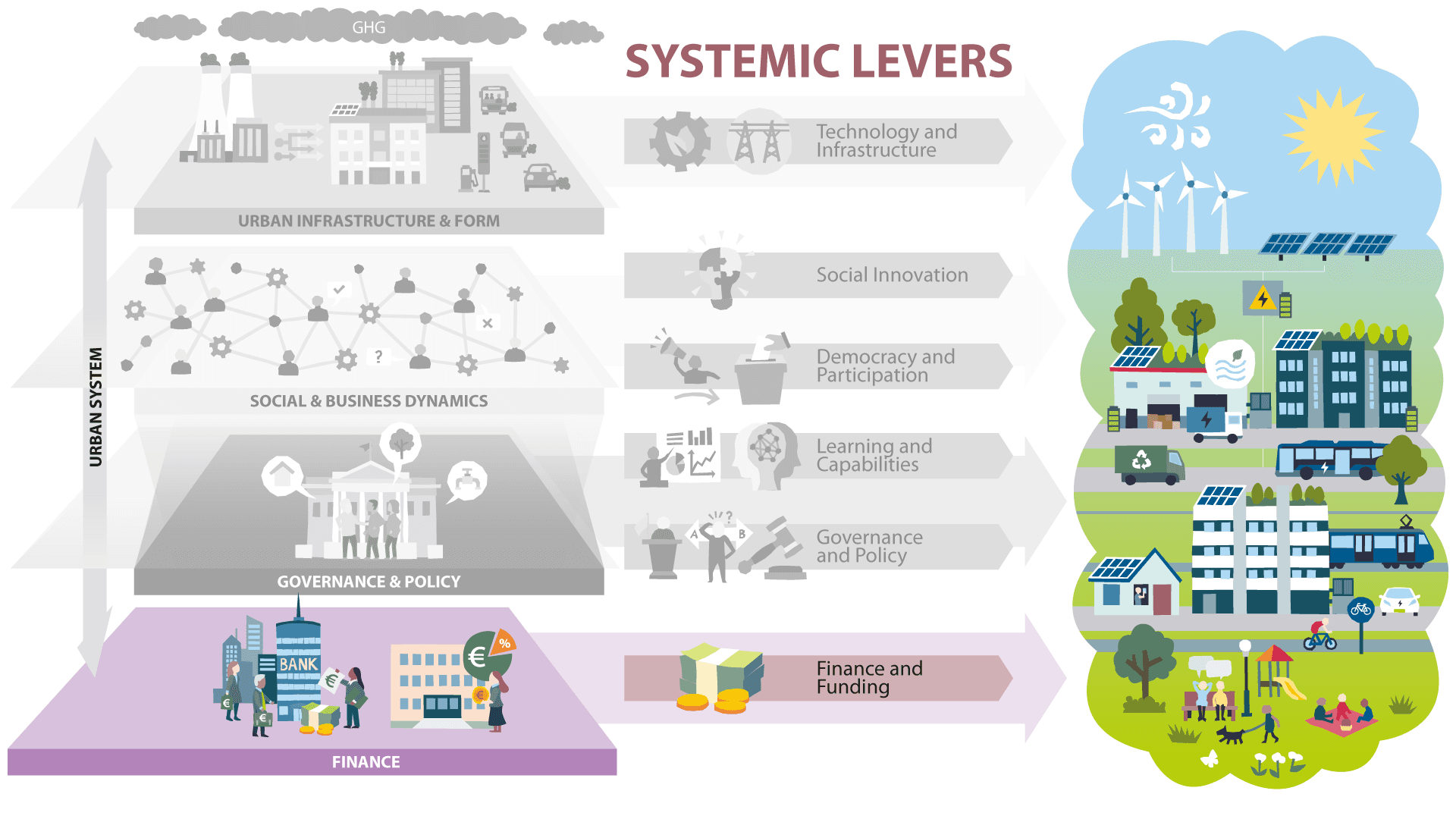

Systemic Levers
image
This page provides an overview of resources on how municipalities can finance climate action, including investors' typology, business models, projects selection and pipeline, and preparation for financing
location_pin
Financing the Ambition

Cities are at the forefront of Europe’s decarbonisation efforts. Through the EU Mission on Climate-Neutral and Smart Cities, they are leading the way in designing and implementing Climate Action Plans that set out pathways to climate neutrality by 2030. This ambition is vast, and while cities are demonstrating leadership, they cannot finance this transformation alone.

Recognising this challenge, the NetZeroCities programme has developed a set of dedicated tools, frameworks, and support services to help both Mission and non-Mission Cities mobilise the capital required to reach their climate goals. These resources are designed to guide cities through the complexity of investment planning, financing options, and project preparation ensuring that they can turn ambition into action.

On this page, you will find the collection of NetZeroCities resources on the topic of Finance.

Reading Resources
NetZeroPlanner Model Overview
The document provides an overview of the NetZeroPlanner model, which helps cities quantify their economic case for decarbonization by analyzing emissions reductions and associated costs
Co-benefits for net-zero cities
This document explains the use of co-benefits in the NetZeroPlanner tool
Economic model methodology
This document includes a detail explanation of NZP methodology​ behind Passenger transport levers • Freight transport levers • Buildings & heating levers • Electricity levers • Waste levers
CCC Document Completeness and Coherence Checklist
The Climate City Contract (CCC) is the result of a collaborative process aimed at systemically integrating and accelerating action across all sectors and at all governance levels to help your city reach climate neutrality by 2030. The outcome of this process is captured in the CCC document.
CCC - 2030 Climate Neutrality Investment Plan (Guidance and Explanations)
This guidance document is designed to accompany the Investment Plan Template to give Mission Cities a reference point when developing their Investment Plans.
CCC - 2030 Climate Neutrality Investment Plan (template)
The Investment Plan template is designed to give cities’ administration a reference structure for the development of the Investment Plan. This will include potential constituent parts, such as tables and textual elements. This document is designed to adapt to cities’ needs and goals, maintaining a certain level of flexibility and adaptability to the way individual administrations operate. This document is accompanied by an IP guidance, which will provide information to cities on how to develop each activity enlisted in the template.
CCC - 2030 Climate Neutrality Action Plan (template)
This template provides a clear and instructive structure for the 2030 Climate Neutrality Action Plan to be created as one of the three parts to the Climate City Contracts, alongside the commitment document and the investment plan. The template follows a modular approach for cities to fill in section by section in an iterative process. The information collected via this template will serve as a basis for the CCC evaluation process to obtain the Mission Label.
Case Studies
Description The NetZeroCities Course is designed for professionals, policymakers, and changemakers committed to driving climate action.
Bristol's Pilot City Activity: Net Zero Investment Co-Innovation Lab
The Bristol Net Zero Investment Co-innovation Lab is to create a series of financial mechanisms to accelerate decarbonisation of the city, facilitating investment and supporting zero carbon business growth. It will develop financial mechanisms that can become self-sustaining and mutually supportive, enabling a fast and fair transition to net zero.
Grenoble Alpes Métropole’s Citizen Convention for Climate
This resource examines Grenoble Alpes Métropole’s participatory climate convention, showing how strong political commitment, stakeholder engagement, and dedicated funding enabled the co-creation of climate mitigation strategies with citizens. It also highlights key challenges—such as coordination, planning, and costs—while offering lessons on how to design impactful, legitimate, and replicable citizen assemblies.
Wards Corner, Public-Commons Partnership (PCP)
This case study presents Wards Corner in London, where a Public-Commons Partnership (PCP) enables community co-ownership and democratic governance of a local market redevelopment. It shows how community-led models can shape urban development, preserve local economies, and promote inclusive, shared decision-making.
Citizens' Climate Assembly
The Citizens' Climate Assembly was a deliberative process of 100 people chosen by lottery between the ages of 16 and 75 to discuss the climate emergency situation in the city and they defined actions and solutions to improve it, answering the question: What can we do to address the climate emergency?
Showcase
Learning from Cities

A map is loading