
NZC Systems Perspectives

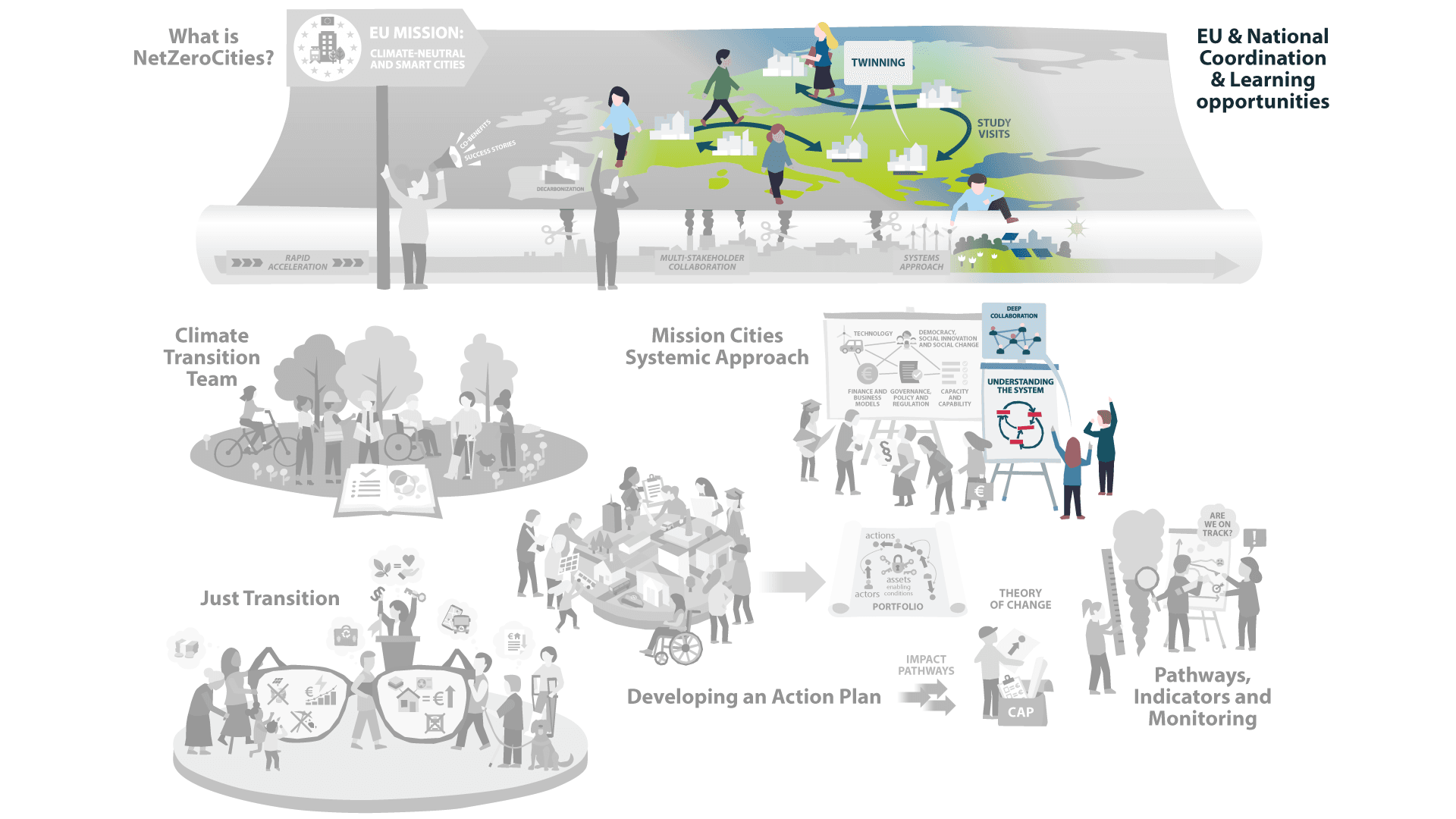
Getting Started
Getting Started

Mission Cities Systemic Approach

Climate Transition Team

Developing an Action Plan

Pathways, Indicators & Monitoring

EU National coordination learning Opportunities

Just transition
This page provides resources classified by EU language and country-specific information

EU National coordination learning Opportunities
This page provides resources classified by EU language and country-specific information
Reading Resources
Accelerating Just Transitions: Insights for Cities and National Platforms
This online repository collects a set of insights that aims to help city representatives and city support agents, such as national platform facilitators, to integrate a Just Transition approach into city climate action.
Quick Read content: The role of Philanthropy within the mission
-
Online Planning Lab: Module 6 - Spotlight session 3: Just transition
Information on the session: Just Transition. What do we mean by just Transition? how to apply a just transition lens on governance and city led projects
National Platforms to Transform Cities Using Collective Experimentation and Scale: The Case of Sweden and Spain
Chapter 8 of the book “Higher Education and SDG11: Sustainable Cities and Communities” . This text is based on the content of Chapter 8 of the book “Higher Education and SDG11: Sustainable Cities and Communities” and analyses the unique role of universities in the creation and consolidation of national platforms of cities working to become healthier, more liveable places while achieving climate neutrality.
EnergyNet and the Future of Local Energy Systems A Viable Cities Outlook on a New Energy Society
EnergyNet is an outlook that explores how cities can build a new, local-first energy system by integrating renewable generation, storage, flexibility and digital coordination into one coherent framework. It is useful for cities and stakeholders because it shows how this approach can make energy cleaner, more resilient and more affordable—while enabling just, community‑centred climate‑neutral transitions.
Viable Cities, Sweden
This resource presents Viable Cities’ mission‑based approach to accelerating climate‑neutral urban development through Climate City Contracts, cross‑sector collaboration, and innovative governance tools. It is useful for cities seeking tested methods to organise, finance, and scale their climate‑transition efforts.
Network of ambitious cities on climate neutrality grows to 184 on EU Cities Mission peer-learning programme
The Twinning Learning Programme is a 17-month programme that aims to transfer knowledge and build capacities across the Pilot Cities and Twin Cities engaged in the programme.
Local Portfolio Analysis - A test of government support for urban transitions
This case presents a pilot initiative that helps municipalities map and analyze their externally funded innovation projects, enabling them to build coordinated project portfolios aligned with climate‑neutrality goals. It is useful for cities and stakeholders because it improves oversight of past initiatives, strengthens strategic planning and future funding applications, and supports smarter, mission‑driven investment decisions for accelerated climate action.
Spotlight on National Climate City Contracts
This case explains Sweden’s Climate City Contract (CCC) 2030, an evolving multi‑level governance framework that strengthens collaboration between cities, national agencies, and Viable Cities to accelerate the transition to climate‑neutral and sustainable cities. It is useful for cities and stakeholders because it aligns policies, coordinates funding, supports innovation and scaling, and provides practical tools and processes (e.g. climate investment planning, smart policy development, and EU engagement) to overcome barriers and speed up climate action.
Scientific Evidence and Publications
Building Institutional Capacity to Plan for Climate Neutrality: The Role of Local Co-Operation and Inter-Municipal Networks at the Regional Level
This paper explores how municipalities develop the institutional capacity needed to integrate climate‑mitigation goals into spatial planning, offering practical insights from 26 cities in Stockholm County. It is valuable for cities and stakeholders working on climate neutrality because it identifies effective governance structures, the importance of dedicated climate staff, and the benefits of regional and inter‑municipal networks for strengthening knowledge and accelerating climate action.
Promoting Urban Net Zero Transitions Through Multi-Level Governance: The Intermediary Role of Systemic Collaborative Platforms
This paper conceptualizes a new type of intermediary actor, the Systemic Collaborative Platform (SCP). Using the example of a multi-stakeholder arrangement set up to design and implement Madrid’s Climate Neutrality Roadmap, the key features of an SCP include a focus on multi-stakeholder and cross-sectoral collaboration for public policy development, in this case operating at both a systemic level and a city scale, and a strong link to a key actor within this regime (a city council).
Visions for climate neutrality and opportunities for co-learning in European cities
This paper synthesises climate‑neutrality visions and barriers across 362 European cities, offering comparative insights and nine high‑level recommendations based on the experiences of the 112 Mission Cities working toward climate neutrality by 2030. It provides cities and stakeholders with actionable evidence to identify common challenges, learn from peers, and mobilise more integrated, inclusive, and transformative climate action.
Cities and Governance for Net-Zero: Assessing Procedures and Tools for Innovative Design of Urban Climate Governance in Europe
This paper reviews key procedural governance tools used in urban energy transitions and evaluates them through the REPAIR framework to assess how well they support transformational, inclusive, and adaptive climate governance. It is valuable for cities and stakeholders seeking to strengthen their governance approaches and ensure that local climate actions are backed by robust, effective, and context‑appropriate decision‑making processes.
Achieving 100 climate neutral cities in Europe: Investigating climate city contracts in Sweden
This paper analyses Sweden’s first Climate City Contracts (CCC) developed under the Viable Cities programme and compares them to best‑practice deep decarbonisation frameworks. It is useful for cities and stakeholders because it offers early insights into how CCCs can be designed and implemented to support climate‑neutrality efforts across Europe and strengthen local–national collaboration.
Systemic intermediaries and transformative climate governance capacities in cities: A case study of the Strategic Innovation Programme Viable Cities
This thesis examines how Viable Cities, acting as an intermediary, strengthens transformative climate governance capacities across Swedish municipalities, highlighting the roles of coordination, innovation, and alignment among diverse urban actors. It offers valuable insights for cities and stakeholders seeking to build the institutional capabilities needed to accelerate climate neutrality.
Fostering Urban Climate Transition Through Innovative Governance Coordination
This paper analyses how the Swedish innovation programme Viable Cities and its “Climate-neutral Cities 2030” initiative have strengthened cities’ capacity to achieve climate neutrality through multi-level governance, coordinated instruments, and structured collaboration. It is useful for cities and stakeholders because it demonstrates how intermediaries can connect local, national, and European efforts, enabling more effective climate action and transformative innovation.
Case Studies
Description The NetZeroCities Course is designed for professionals, policymakers, and changemakers committed to driving climate action.
The Role of Philanthropy in Southern Italy’s Community Energy Transition
-
The Role of Philanthropy in Turin’s Urban Climate Transition
This case study examines the contribution of Fondazione Compagnia di San Paolo to Turin’s pathway toward climate neutrality through two complementary initiatives: the CLICC project and the TPL Carbon Free Innovation Center. Together, these initiatives illustrate how philanthropy can operate both as a builder of systemic urban capacities and as an accelerator of sector-specific innovation. Rather than acting solely as a source of funding, the foundation plays a strategic role in strengthening governance, enabling experimentation and fostering collaboration across institutional and sectoral boundaries.
The region as a signatory of the Climate City Contract, Region of Valencia, Spain
This case illustrates how the long‑standing collaboration between the Valencia Region and the City of València has created an integrated governance model that aligns regional and local powers to advance the València 2030 Climate Mission. It is useful for cities and stakeholders because it shows how coordinated mitigation‑and‑adaptation planning, shared climate governance, and strategic use of national and EU funding can accelerate climate‑neutral and resilient urban transitions.
Strengthening Just Transitions Through the Core Functions of National Platforms
National platforms are to support cities and accelerate European climate agendas by strengthening coordination and cooperation across governance levels. Working with diverse stakeholders brings challenges related to differing interests and power dynamics. Applying a Just Transition perspective helps national platforms address these challenges and foster more balanced, inclusive and fair climate action processes.
Supporting cities in achieving their climate neutrality objectives: Poland
The Polish national platform for facilitating the implementation of the Cities Mission was launched at the end of 2023. Its objective is to foster closer collaboration and alignment among the national, regional and local levels, and to provide direct support to the five Mission Cities in their climate neutrality work
Viable Cities Journey: Climate transition through Collaboration and Multi-level Governance
This resource presents Viable Cities’ mission-driven governance model—combining Climate City Contracts, transition teams, transition arenas, and Climate Investment Plans—to help cities break silos and mobilise all actors for climate neutrality by 2030. It is valuable for cities and stakeholders seeking practical, scalable methods to strengthen collaboration, secure long‑term commitment, and accelerate the transition in line with the EU Cities Mission.
Making EU Missions a priority in Blekinge Regional Smart Specialisation Strategy
This resource outlines how the Blekinge Region is using the EU Missions as a driver for regional development by integrating climate neutrality, climate adaptation, and healthy oceans into its smart specialisation strategy. It is valuable for cities and stakeholders because it demonstrates how mission‑oriented approaches can strengthen regional collaboration, unlock EU funding, support innovation pilots, and build the systemic capacity needed to accelerate climate‑neutral and resilient transitions.
National Platform: France
This resource explains how France is advancing the EU Cities Mission through the National Groupe Miroir Ville (GMV), an informal yet increasingly influential coordination space that brings together ministries, agencies, cities, networks, and research institutions. It is useful for cities and stakeholders because it shows how regular exchange, shared learning, and emerging multi‑level collaboration can strengthen climate governance, support the development of Climate City Contracts, and build the foundations for effective implementation despite limited formalisation and funding.
National Platform: Italy
This resource outlines how Italy is building an emerging national ecosystem for climate‑neutral cities by connecting Mission Cities, national ministries, networks, and technical teams through shared processes and collaboration spaces. It is useful for cities and stakeholders because it shows how multi‑level coordination, continuity, and shared learning can help sustain climate action even amid institutional change, offering inspiration for developing similar national platforms elsewhere.
citiES 2030: Spain
citiES 2030 is Spain’s national platform that empowers Mission Cities and Mission‑minded cities to accelerate their transition to climate neutrality through multi‑level coordination, shared learning, and collaborative project development. It is a valuable resource for cities and stakeholders because it connects local actors with national and European frameworks, mobilises expertise and funding, and supports the co‑creation of scalable solutions for urban transformation. It deeps dive on the origin and evolution of citiES 2030
Towards a National Platform: Türkiye
Türkiye's Climate‑Neutral Cities Network (İNŞA) brings together 55 municipalities in a nationally coordinated effort to accelerate climate neutrality through capacity building and peer learning. It shows how a country outside the EU can successfully build a national ecosystem for climate‑neutral cities, offering practical lessons on coordination and scaling Mission‑oriented approaches.
Spotlight on National Platforms
The case describes what a National Platform is and highlights its added value for cities, showing how it strengthens coordination across governance levels, removes implementation barriers, and provides practical tools, funding pathways, and peer‑learning opportunities to accelerate climate action.
Related Project and initiatives (external)
Resources from Other Projects
Learning from Cities
A map is loading
You May Also Like

The Netherlands: Report on Dutch National Support Structure and analysis of Dutch CCCs
Mission-Oriented Country Platforms: Engines for a just green transition
Are ‘Country Platforms’ the Key to Delivering Green Growth at Scale?
Building strategic foresight and anticipatory capacity and knowledge in government
Catalyzing Aggregated Purchasing Power: The Role of Private and Public Intra-City Procurement for Advancing City Climate Action