
NZC Systems Perspectives

Getting Started
Getting Started

Mission Cities Systemic Approach

Climate Transition Team

Developing an Action Plan

Pathways, Indicators & Monitoring

EU National coordination learning Opportunities

Just transition
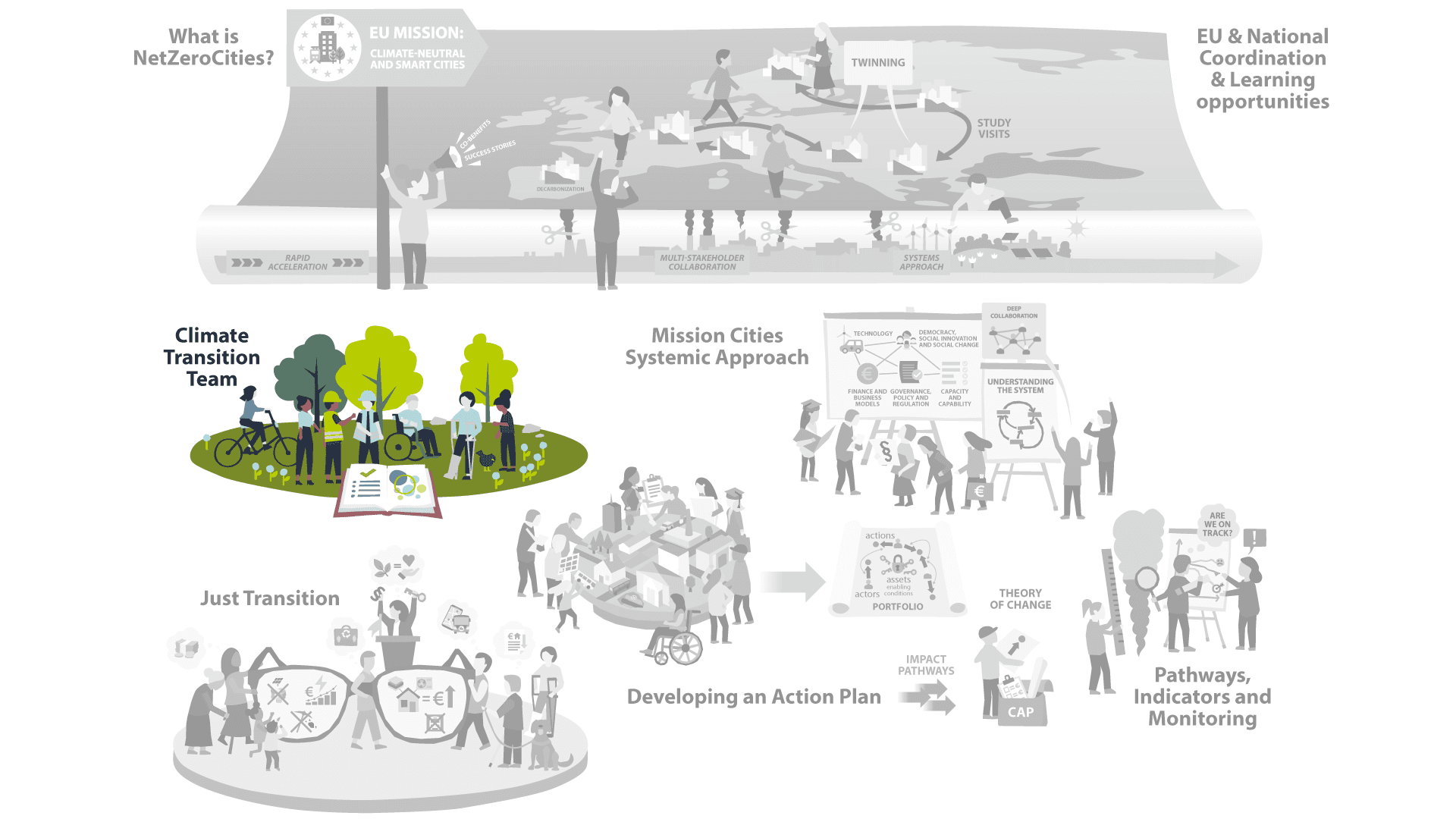
How can you strengthen your role in leading the climate transition through building a stronger mandate and fostering collaboration across teams? In this page you will find resources to explore how to strengthen your mandate and build internal support, to understand how building relationships can lead to better collaboration and outcomes.

Climate Transition Team
How can you strengthen your role in leading the climate transition through building a stronger mandate and fostering collaboration across teams? In this page you will find resources to explore how to strengthen your mandate and build internal support, to understand how building relationships can lead to better collaboration and outcomes.
Reading Resources
Transition team playbook
This playbook is a guide to develop a city’s ability to lead to orchestrate a transition bringing together diverse actors and stakeholders across all sectors
Transition teams: Spotlight on the crews steering cities to climate neutrality
This article explains how transition teams enable cities to organise, coordinate, and accelerate their climate‑neutrality efforts. It provides practical lessons for stakeholders looking to build effective governance structures that turn ambitious climate commitments into real, collective action.
Transition Team Support Programme #5 - Vilnius presentation
This presentation was delivered by Vilnius on 4 November 2025 as part of the Transition Team Support Programme. It showcases how the city is building a long-term climate action ecosystem, starting with a Sustainability Managers’ Club to strengthen interdepartmental collaboration and progressing towards a Climate Hub to support CCC implementation, funding, and community engagement. It highlights how cities translate governance, mandate, and skills into concrete structures and practices through learning by doing.
Transition Team Support Programme #5 - Nantes presentation
This presentation was presented by Nantes on 4 November 2025 as part of the Transition team Support Programmes, showcase the internal dynamics of their Transition Team, highlighting the importance to secure legitimacy across a large municipal administration and to build a shared culture of climate leadership among staff and elected representatives.
Transition Team Support Programme #5 Milan presentation
This presentation by Milan on 4 November 2025 as part of the Transition team Support Programmes showcase the Milan/CLIMB CLimate-neutrality through Integrated Molecular model for urBan regeneration with sustainable finance
Transition Team Support Programme session #4
This slide deck supported the online webinar of the Transition Team Support Programme focusing on Building Capacity for impact: Developing skills and competencies for the Transition
Transition Team Support Programme #3 - presentation slides
This slide deck presents a Transition Team webinar on mandate and power, exploring how to build, strengthen, and institutionalise climate mandates using formal and informal levers. It includes Lund’s example of portfolio mapping to translate climate goals into actionable projects and embed long-term commitment in city operations.
Transition Team Support Programme Webinar #2
This is the slide deck presentation of the Transition Team Webinar exploring governance models for Transition Teams, highlighting the role of networked governance in coordinating climate action across sectors and stakeholders. It shares Umeå’s example of decentralised teams and capacity-building programmes to enable collaboration and innovation in the transition.
Transition Team Support Programme - recap
This resource summarises the Transition Team Support Programme, highlighting key lessons on governance, mandate, skills, and experimentation from European Mission Cities. It shows how cities can structure and operationalise Transition Teams to strengthen coordination, capacity, and implementation of climate action.
Presentation: Cities prototyping Transition Team approaches
Presentation of the session on Learning by doing: Cities prototyping Transition Team approaches
Transition team and climate leadership presentation at the NZC online planning lab
How to strengthen your role in leading the climate transition through building a stronger mandate and fostering collaboration across teams
Scientific Evidence and Publications
Urban transition governance in practice: exploring how European cities govern local transitions to achieve climate neutrality
This article analyses how cities participating in the EU Cities Mission are beginning to operationalise transition governance through Climate City Contracts, assessing early practices in coordination, co‑creation, anchoring, and learning. It offers valuable insights for municipalities and stakeholders seeking to strengthen their governance approaches and accelerate effective, context‑sensitive pathways to climate neutrality by 2030.
Transition Teams as an Innovative Tool in a Higher Education Institution on the Road to Sustainability: A Case Study
This chapter describes how a Higher Education Institution integrated the SDGs into its strategy, policy, and curriculum through a co‑creation process with CIFAL Flanders and the Multi-Level Perspective transition approach. It offers a practical model for HEIs and other organisations seeking to build internal transition capacity and embed sustainability in their operations with broad societal impact.
Transformative low-carbon urban innovations: Operationalizing transformative capacity for urban planning
This paper synthesizes research on low‑carbon people‑based and nature‑based innovations to identify the characteristics that give them transformative capacity in urban planning. It is useful for cities and stakeholders because it translates abstract transformative‑capacity frameworks into practical insights that help planners recognize, design, and scale innovations capable of accelerating sustainability transitions.
Planning Education and Transformative Capacity for Climate-Neutral Cities
This paper explores how strengthened transformative capacities—particularly through enhanced planning education—can support Swedish municipalities in advancing toward climate neutrality. It is useful for cities and stakeholders because it highlights the evolving skills, roles, and knowledge planners need to drive rapid urban transformation and meet local climate goals.
Governing climate neutrality transitions at the urban level: A European perspective
This paper examines how nearly 400 European cities are reshaping their governance systems to meet climate‑neutrality goals, drawing on data from the EU Cities Mission. It is valuable for cities and stakeholders because it highlights emerging governance practices, stakeholder participation models, and persistent challenges—such as climate finance—that are critical for effective local climate action.
Strategizing for Climate Neutrality. How to Make Social Innovation Relevant in the City’s Journey to Climate Neutrality
This chapter provides guidance for cities on accelerating their path to climate neutrality by leveraging social innovation, collaborative governance, and systemic transformation. It is useful for cities and stakeholders as it outlines practical approaches—such as Transition Teams, action portfolios, cross‑sectoral mobilisation, and the Climate Transition Map—to support effective planning, learning, and capability building for sustainable urban transitions.
Learning from Cities
A map is loading